OEM Planning

OEM Nitrided Wok Project Planning

Use this OEM nitrided wok project page to prepare RFQ details, samples, packaging, care instructions, quality checks, and production planning.

Buyer takeaway

This page is for OEM nitrided wok buyers. Carbon steel is treated as the base material explanation, while nitriding remains the main surface treatment topic for sourcing, packaging, care instructions, and quality control.

  • Cookware brands preparing RFQ documents
  • Private label sourcing teams
  • Importers comparing sampling routes
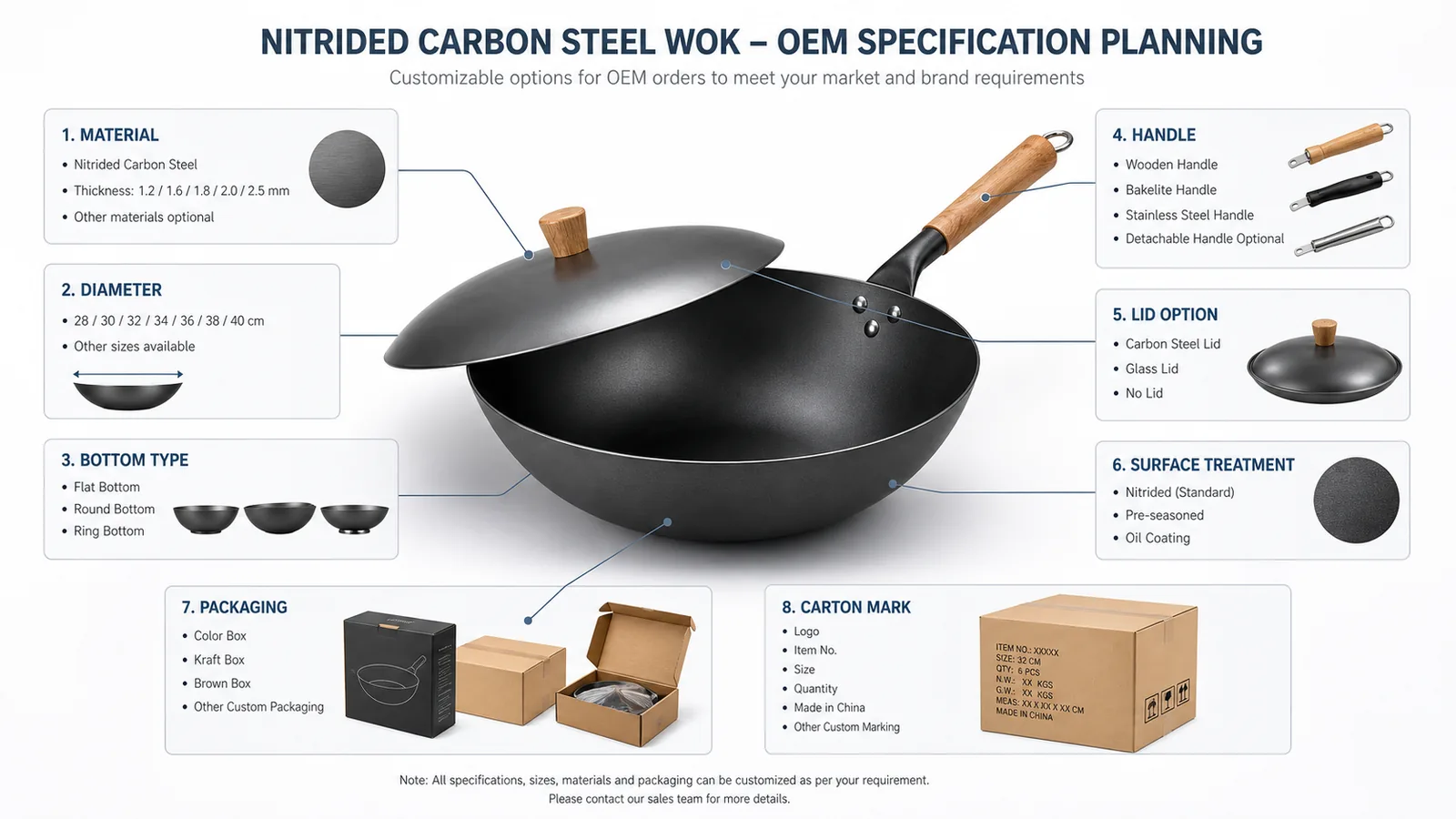
OEM nitrided carbon steel wok specification planning visual

OEM project sequence

A practical OEM nitrided wok project usually moves through RFQ, feasibility review, sample, packaging proof, production, inspection, and shipment.

What to send

Send the target wok type, diameter, base material, bottom type, surface treatment expectation, handle, lid, packaging, care card, logo files, target market, estimated quantity, and launch timeline.

Buyer Planning Table

Details to confirm before sampling

Decision pointBuyer note
Base materialConfirm carbon steel or iron route before naming and packaging.
Surface treatmentDescribe nitriding as surface treatment, not coating.
Care instructionsInclude washing, drying, oiling, and storage guidance.
Quality controlCheck surface, rust spots, bottom flatness, handle fixing, lid fit, and packaging.
Is this a nonstick coating?

No. Nitriding should be described as a surface treatment route, not as PTFE, ceramic coating, or a maintenance-free nonstick layer.

Is carbon steel the base material?

For many projects, yes. Carbon steel or iron is the base material, while nitriding is the surface treatment that affects surface appearance, care notes, inspection, and packaging claims.

What should buyers confirm before sampling?

Confirm wok type, diameter, base material, bottom type, handle, lid, surface treatment expectation, packaging, care card, target market, quantity, and sample deadline.

What quality checks matter?

Surface consistency, rust spot inspection, bottom flatness, handle fixing, lid fit, packaging moisture protection, and care instruction accuracy are important checks.

WA